

Combed Cotton 400T Hotel Bed Sheets
Smooth Silky Soft Touching Feeling
Different Pattern Design & Thread Count Hotel Bed Sheets

1cm Stripe Hotel Bed Sheets
Classic 1cm stripe hotel bed sheets widely used in business hotels and hospitality projects. Available in cotton and polycotton options.

3cm Stripe Hotel Bed Sheets
Elegant 3cm stripe design suitable for hotels, resorts and serviced apartments. Available in different thread count options.
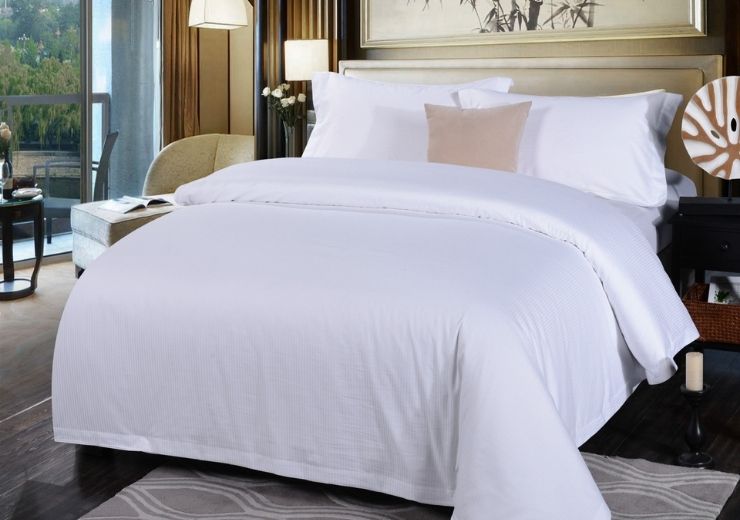
5mm Stripe Hotel Bed Sheets
Premium narrow stripe hotel bed sheets designed for upscale hospitality environments with a clean and refined appearance.

Plain White Hotel Bed Sheets
Simple and timeless white hotel bed sheets suitable for commercial hospitality use and repeated industrial washing.

Grid Pattern Hotel Bed Sheets
Textured grid pattern hotel bed sheets designed for comfort, durability and modern hospitality presentation.

Check Pattern Hotel Bed Sheets
Classic check pattern hotel bed sheets suitable for hotels and hospitality projects looking for decorative bedding styles.

Damask Hotel Bed Sheets
Elegant damask pattern hotel bed sheets designed for premium hotel rooms and luxury hospitality
projects.

Wave Pattern Hotel Bed Sheets
Modern wave pattern hotel bed sheets with soft touch and refined hospitality
appearance.
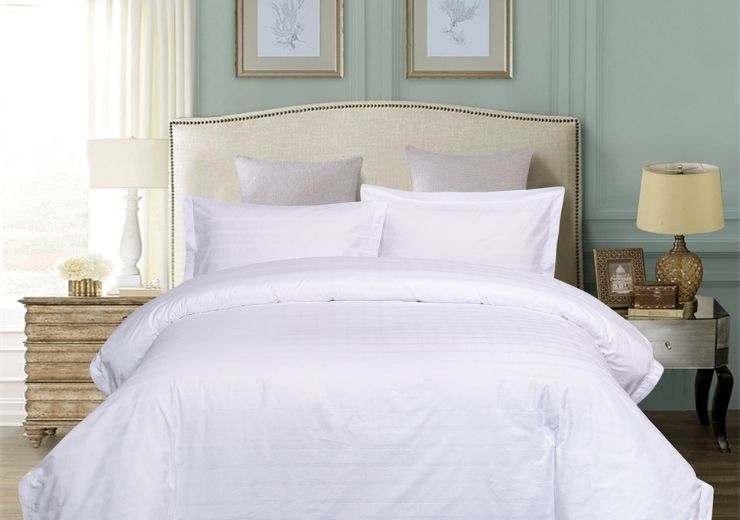
4-Line Grid Hotel Bed Sheets
Decorative 4-line grid design hotel bed sheets suitable for upscale hotel bedding collections and hospitality projects.


Care Instruction for White Color Hotel Bed Sheets
Pre-Washing
- All new hotel bed linens(bed sheet, fitted sheet, duvet cover, pillow case,pillow protector)need to do pre-wash to remove dust, stray fibers.
- Please usea mild detergent,half as much as normal washing in cool or warm water(30°C)
- Please do not overload the washing machine to avoid great friction and damage on products.
- Please use a tumble dryer rather than drying under sun, to avoid cotton bed linen products change to yellow.
Main Washing
- Wash hotel bed linen at a maximum of 40°C in the main wash by a gentle wash and spin cycle programme. Select for a programme with a long rinse cycle to make sure that wash out any excess detergent.
- Please do not overload the washing machine to avoid great friction and damage on products.
Drying
- Please use a tumble dryer rather than drying under sun, to avoid cotton bed linen products change to yellow.
- To minimize creasing when using a tumble dryer, do not overload and overdry.
- Please remove thehotel bed linen products from the washing machine or tumble dryer immediately after wash and drying.
Ironing
- The best time to iron is when bed linenis slightly damp as it will be easier.
- Set your iron to cotton and use steam whennecessary.
Storing
- Please store in a cool, dry and well-ventilated space away from direct sunlight.
Warranty Period:
One Year/If it is not caused by artificial damage, washing damage or natural aging of the product, we will replace it without charge.
Sample:
Sample production time: 7 days.
Cost: free for samples, we can supply you samples by free to do lab test or wash test before officila order to make sure quality. For delivery cost of samples, you can provide me your express account.
Production Lead Time:
Normally we need 30 days in production for full set of bed linens ,bath linens for one hotel project, including bed sheet, duvet cover, pillow case, pillow protector, mattress protector, mattress topper, bed runner, cushion, bed skirting, towels, bathrobe, slippers.If something urgently, pls contact us first to discuss.
Hotel Bed Sheet Collection
Commercial hotel bed sheets designed for hospitality projects, hotels, resorts and serviced apartments.
Available in different thread counts, stripe designs and fabric constructions to match various hospitality standards and project requirements.
1. Why Do Hotels Use White Bed Sheets?
White hotel bed sheets have become the industry standard for both operational and guest experience reasons.
First, white bedding immediately gives guests a feeling of cleanliness, freshness, and hygiene. Any stains or damage can be identified quickly, which helps hotels maintain higher housekeeping standards.
Second, white bed linen creates a timeless luxury appearance. Whether it is a business hotel, resort, serviced apartment, or boutique hotel, white sheets match almost every room style and interior design.
From the hotel operations side, white bed sheets are also easier to:
- Wash commercially
- Bleach safely
- Replace in batches
- Maintain color consistency over time
This is why most international hotel brands continue using white hotel bedding for both practicality and guest perception.
2. What’s The Difference Between Fitted Sheets And Flat Sheets?
Flat sheets are traditional rectangular bed sheets with hemmed edges. They are widely used in hotels because they are easier to iron, fold, and process in commercial laundries.
Fitted sheets include elastic corners that wrap tightly around the mattress. They create a cleaner appearance and help reduce sheet movement during guest use.
In hospitality projects:
- Flat sheets are often preferred for easier industrial washing and lower replacement cost
- Fitted sheets are commonly used in premium hotels and modern hospitality projects for better presentation
Many hotels use both together as part of a complete hotel bedding setup.
3. What’s The Difference Between Top Sheets And Bottom Sheets?
A top sheet is placed between the guest and the duvet or blanket. It helps protect the duvet insert and reduces washing frequency for the duvet cover.
A bottom sheet is the sheet placed directly over the mattress. It acts as the primary sleeping surface for guests.
In commercial hospitality operations, using top sheets can help:
- Extend duvet lifespan
- Reduce laundry costs
- Improve bedding hygiene
Simplify housekeeping replacement cycles
4. What Are The Most Popular Fabrics For Hotel Bed Sheets?
The most common hotel bed sheet thread counts are:
- 200TC
- 250TC
- 300TC
- 350TC
- 400TC
Different hotel categories usually choose different specifications based on guest positioning and operating budgets.
Common hotel bed sheet designs include:
- White plain bedding
- Satin stripe bedding
- Jacquard hotel bedding
- Percale bedding
- Embroidered bedding
For most hotels, the goal is not simply softness, but the balance between:
- Guest comfort
- Commercial laundry durability
- Cost control
Long-term replacement efficiency
5. What Kind Of Bed Sheets Do 5-Star Hotels Use?
Most luxury hotels and five-star resorts prefer 300TC to 400TC hotel bedding because it offers a better balance of:
- Softness
- Breathability
- Durability
- Premium guest feel
High-end hospitality brands often use:
- Cotton sateen bedding
- Satin stripe hotel sheets
- Long-staple cotton fabrics
- Luxury white bedding collections
However, professional hotel buyers know that thread count alone does not determine quality. Fabric construction, yarn quality, weaving technology, and finishing processes are equally important.
6. What Are The Key Factors To Test Hotel Bed Sheet Quality?
Professional hospitality buyers usually evaluate hotel bed linen from several important aspects.
Cotton Quality
Long-staple cotton generally creates:
- Better strength
- Softer hand feel
- Longer service life
Cotton quality directly affects how the bedding performs after repeated industrial washing.
Thread Count And Fabric Construction
Thread count influences fabric density and comfort, but higher thread count does not always mean better bedding.
Hotels usually focus more on:
- Commercial durability
- Breathability
- Wrinkle performance
- Laundry efficiency
Bleaching And Finishing Process
Good mercerizing and bleaching processes help improve:
- Fabric smoothness
- Whiteness
- Shrinkage stability
- Fiber protection
Poor finishing can cause faster fabric damage after washing.
Weaving Technology
Air-jet loom weaving is widely used in professional hotel bedding manufacturing because it improves:
- Fabric consistency
- Production efficiency
- Surface smoothness
Sewing Quality
Strong stitching and reinforced seams help prevent:
- Open seams
- Fabric tearing
- Shortened service life
especially under heavy commercial laundry conditions.
7. What’s The Difference Between 100% Cotton And Cotton-Polyester Blend Bedding?
100% cotton hotel bedding usually feels softer, more breathable, and more luxurious. It is widely used in upscale hospitality projects and luxury hotels.
Cotton-polyester blend bedding offers:
- Better wrinkle resistance
- Longer commercial lifespan
- Faster drying
- Lower operating cost
This is why many hotels, laundries, and serviced apartments choose polycotton bedding for high-frequency commercial use.
For hospitality buyers, the right choice depends on:
- Hotel positioning
- Laundry system
- Guest expectations
Replacement budget
8. What Is The Best Cotton For Hotel Bed Sheets?
Several cotton types are commonly used in hospitality bedding.
Egyptian Cotton
Known for softness and luxury positioning. Frequently associated with premium hotel bedding collections.
Pima Cotton
A long-staple cotton with strong fibers and smooth texture.
Supima Cotton
A branded American extra-long staple cotton with strict quality standards.
Xinjiang Cotton
Widely used in commercial hotel bedding manufacturing because of:
- Stable fiber quality
- Good strength
- Competitive cost
- Reliable large-scale production
Many professional hotel linen factories use Xinjiang cotton for commercial hospitality projects worldwide.
9. What Is Percale, Twill And Sateen?
These terms refer to different weaving structures used in hotel bed sheet fabrics.
Percale
Percale uses a one-over-one weave structure. It creates:
- Crisp feel
- Better breathability
- Matte appearance
Percale hotel bedding is popular in warmer climates and luxury hospitality projects.
Twill
Twill weaving creates diagonal fabric lines and stronger structure, although it is less commonly used in hotel sheets.
Sateen
Sateen weaving creates:
- Smoother surface
- Softer touch
- Slight sheen appearance
Sateen hotel bedding is commonly used in luxury hotels because it feels softer and more elegant.
10. What’s The Difference Between Percale And Sateen Hotel Bedding?
Percale bedding feels cooler, crisper, and more breathable. It is ideal for:
- Warm climates
- Luxury resorts
- Hotels preferring a fresh hotel-sheet feeling
Sateen bedding feels smoother and silkier with a softer drape. It is commonly used in:
- Five-star hotels
- Luxury suites
- Premium hospitality brands
Both are widely used in the hospitality industry depending on hotel positioning and guest preference.
11. What Is Thread Count In Hotel Bedding?
Thread count refers to the total number of horizontal and vertical yarns within one square inch of fabric.
For example:
200TC means the combined warp and weft yarn count equals 200 threads per square inch.
However, professional hotel buyers understand that:
- Yarn quality
- Weaving method
- Finishing process
- Fabric construction
are often more important than thread count alone.
12. What Thread Count Is Best For Hotel Bed Sheets?
Different hotels use different thread counts depending on their positioning.
Generally:
- 200TC: Economy hotels and institutional projects
- 250TC: Mid-range hotels
- 300TC–400TC: Luxury hotels and resorts
- 500TC+: High-end luxury collections
For most hospitality projects, 300TC hotel bedding provides one of the best balances between:
- Comfort
- Durability
- Commercial laundry performance
Cost efficiency
13. Which Thread Count Feels The Softest?
Softness depends on more than just thread count.
Fabric softness is also influenced by:
- Yarn quality
- Finishing process
- Weaving structure
- Mercerizing treatment
Well-constructed 300TC or 400TC hotel bedding often feels softer and more comfortable than extremely dense 600TC fabrics.
14. What Is Considered Luxury Thread Count?
In hospitality bedding, luxury thread count is usually considered:
- 300TC
- 350TC
- 400TC
Although 600TC sounds more luxurious in marketing, many professional hotel buyers find that excessively high thread counts can reduce breathability and increase fabric heaviness.
This is why many five-star hotels continue using premium 300TC–400TC bedding collections.
15. Are 400TC Hotel Bed Sheets Good?
Yes.
400TC hotel bed sheets are widely used in luxury hospitality projects because they provide:
- Smooth hand feel
- Elegant appearance
- Better drape
- Comfortable sleeping experience
When produced with high-quality cotton and proper weaving technology, 400TC bedding offers an excellent balance between luxury feel and commercial durability.
16. Is Higher Thread Count Always Better?
Not necessarily.
Very high thread counts may:
- Reduce breathability
- Increase fabric weight
- Raise costs significantly
In commercial hospitality operations, bedding must also survive repeated industrial washing.
This is why many professional hotel linen suppliers recommend focusing on:
- Fabric construction
- Yarn quality
- Commercial durability
- Laundry performance
instead of only chasing higher thread count numbers.
17. How Long Do Hotel Bed Sheets Last?
The lifespan of hotel bed sheets depends heavily on:
- Fabric quality
- Laundry conditions
- Washing frequency
- Bleaching process
Generally:
- 100% cotton hotel sheets may last around 150–180 commercial washes
- Polycotton hotel sheets may last around 180–220 commercial washes
Proper industrial laundry management can significantly extend linen lifespan.
18. What Type Of Hotel Bed Sheets Last The Longest?
CVC bedding fabrics are widely known for excellent commercial durability.
CVC fabrics usually combine:
- Cotton comfort on the surface
- Polyester reinforcement inside the structure
This creates:
- Better strength
- Lower shrinkage
- Longer service life
- Better commercial washing performance
which is especially important for hotels, laundries, and linen rental companies.
19. How Can Hotels Make Bed Sheets Last Longer?
Professional hospitality operations usually focus on:
- High-quality fabric selection
- Proper bleaching process
- Correct industrial laundry procedures
- Controlled drying temperatures
- Avoiding excessive chemical use
Choosing reliable hotel linen manufacturers is equally important because stable fabric quality greatly affects long-term linen lifespan.
20. How Often Should Hotels Replace Bed Sheets?
Hotels usually replace bed sheets when they become:
- Visibly worn
- Permanently stained
- Thin
- Damaged
- Less presentable
Luxury hotels often replace linens earlier to maintain a premium guest experience and stronger brand image.
21. How Do Hotels Calculate Bed Sheet Sizes?
Hotel bed sheet sizing is usually calculated based on:
- Mattress width
- Mattress height
- Tuck-in allowance
Hotels also consider shrinkage after washing when confirming production sizes.
Correct sizing is extremely important because undersized sheets create housekeeping problems and poor guest presentation.
22. What Size Bed Sheet Is Used For King Beds?
King size hotel bed sheets are customized based on mattress dimensions and mattress height.
Professional hotel linen suppliers usually recommend confirming:
- Mattress width
- Mattress depth
- Pillow-top thickness
- Shrinkage allowance
before production to ensure better fit after commercial washing.
23. Can Double Sheets Fit Queen Beds?
Technically, double sheets are usually too small for queen mattresses.
However, some hotels standardize sheet sizes across room categories to simplify:
- Housekeeping operations
- Inventory management
- Laundry sorting
This depends on the hotel’s operational strategy.
24. How Do Hotels Distinguish Different Bed Sheet Sizes?
Many hotel linen factories use:
- Colored stitching
- Size labels
- Color-coded bottom hems
to help housekeeping teams quickly identify different sheet sizes during daily operations.
This improves efficiency in:
- Laundry sorting
- Room setup
Inventory control
25. Why Do Some Hotel Sheets Use Wide Top Borders?
Wide top hems help housekeeping staff quickly identify:
- Sheet direction
- Top and bottom orientation
- Bed-making positioning
This improves operational efficiency and creates a cleaner presentation when the bed is made.
26. How Should Hotels Wash Bed Sheets?
Professional hotel bed linen washing usually includes:
- Pre-washing
- Gentle commercial washing
- Controlled drying
- Proper ironing
- Correct storage conditions
Hotels should avoid:
- Overloading washing machines
- Excessive detergent
- High-temperature drying
- Long sun exposure
because these can damage cotton fibers and reduce linen lifespan.
27. Should New Bed Sheets Be Washed Before Use?
Yes.
Pre-washing helps remove:
- Dust
- Loose fibers
- Manufacturing residue
It also allows the fabric to stabilize before hospitality use.
28. Why Do White Hotel Sheets Turn Yellow?
Yellowing may happen because of:
- Excessive heat
- Improper bleaching
- Sweat and body oil buildup
- Chemical residue
- Poor rinsing process
Professional commercial laundry management is critical for maintaining bright white hotel bedding.
29. Do Hotel Bed Sheets Shrink After Washing?
Yes.
Both cotton and cotton-polyester blend bed sheets experience some shrinkage after washing, especially during the first few wash cycles.
Professional hotel linen manufacturers usually calculate shrinkage allowance during production to ensure correct finished size after laundering.
30. What Is The Normal Shrinkage Rate For Hotel Bed Sheets?
Generally:
- 100% cotton hotel bedding may shrink around 5%
- Cotton-polyester blends may shrink around 3–5%
Stable shrinkage control is one of the most important quality indicators for professional hotel linen manufacturing.